
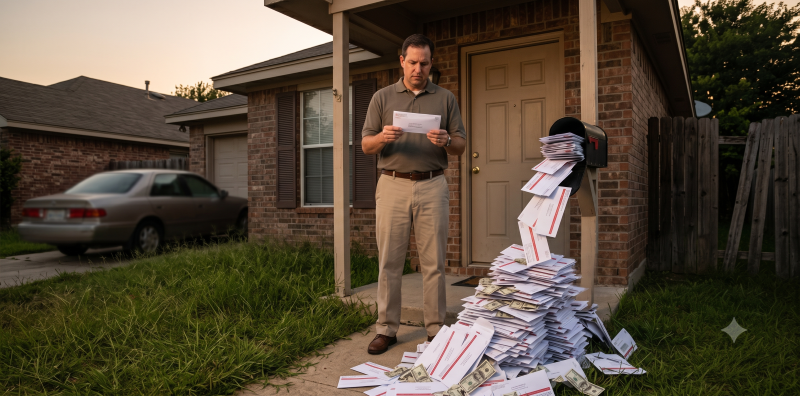
If you own or manage single-family rental properties across the state of Texas, you know that keeping every property in perfect condition 365 days a year is a monumental task. Sometimes, despite your best efforts, things slip through the cracks. A tenant forgets to mow the lawn, an inoperable vehicle is left in the driveway, or a fence board blows down in a storm.
You don't have to be a "slumlord" to get a citation from municipal code compliance. However, if code enforcement does come knocking, the fines they can levy against you are absolutely staggering.
The Thousand-Dollar-a-Day Reality
When a city inspector drives by and spots a violation, they don't just issue a one-time speeding ticket. Code compliance fines accrue daily.
Under Texas Local Government Code § 54.001, municipalities have the broad authority to enforce ordinances regarding zoning, fire safety, and public health and sanitation. Under this statute, cities can assess penalties of up to $2,000 per day for health and safety violations.
Common infractions that trigger these aggressive daily fines include:
- Overgrown grass and weeds
- Inoperable or unregistered vehicles parked on the property
- Broken fences or structural disrepair
- Failure to provide essential utilities, like hot water or winter heating
Because the fines compound daily, the math gets terrifying quickly. If a broken-down vehicle sits in a driveway for 100 days while you try to get the tenant to move it, you could theoretically be facing a $100,000 fine.
The Code Violation "Sentencing Range"
How does a city decide whether to fine you $30 or $1,000 per day? It operates very much like a criminal sentencing range, where the punishment is scaled to the severity of the offense.
If a landlord intentionally cuts off a tenant’s heat in the dead of winter, the city will rightly view that as a severe health and safety hazard. In those egregious cases, the city will absolutely seek the maximum statutory penalty of $1,000 to $2,000 per day.
Conversely, if the violation is merely cosmetic—like grass that has grown a few inches over the local limit—the city is usually willing to negotiate. By actively participating in an administrative hearing, landlords can often get exorbitant fines drastically reduced. For example, a potential $1,000-a-day fine for a yard violation can often be negotiated down to $30 a day. While $30 daily still isn't chump change, it is far better than facing financial ruin over a landscaping issue.
Reputation Matters: The "Slumlord" Target
If you want to avoid having the book thrown at you, your reputation with the city and the courts is your most valuable asset.
While code enforcement officers can issue citations to anyone, they specifically target landlords who have a track record of being bad actors. If a landlord is known to be a slumlord, constantly involved in a dozen different tenant lawsuits, the city will use that history against them. During a hearing, a tenant or city attorney will gladly list every other case you are involved in to paint a picture of systemic negligence.
While it is true that "anyone can file a lawsuit" and being sued doesn't automatically equal liability, municipal judges often follow the rule of where there is smoke, there is fire. If you are constantly dragging your feet on repairs or ignoring citations, the city will use maximum daily fines to force you into compliance or run you out of business entirely.
All information provided on Silblawfirm.com (hereinafter "website") is provided for informational purposes only, and is not intended to be used for legal advice. Users of this website should not take any actions or refrain from taking any actions based upon content or information on this website. Users of this site should contact a licensed Texas attorney for a full and complete review of their legal issues.