
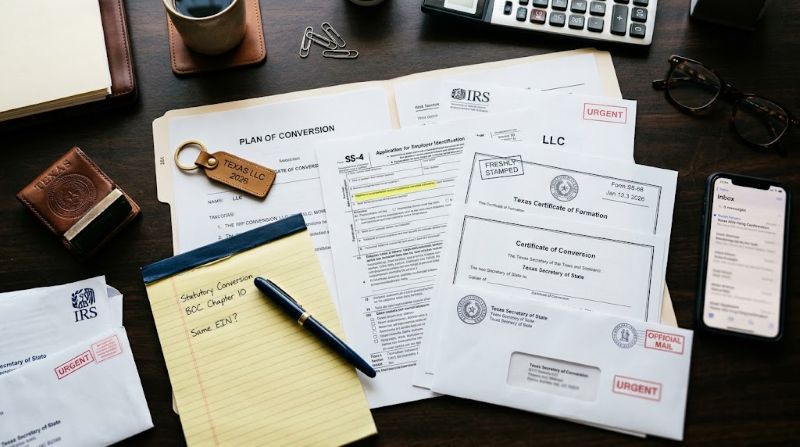
When expanding or relocating a business to Texas, entrepreneurs and business owners often evaluate how best to structure their entities. A frequent question that arises during entity creation is whether a brand-new Texas Limited Liability Company (LLC) can reuse the Employer Identification Number (EIN) from a dissolved out-of-state LLC.
Understanding federal tax guidelines set by the Internal Revenue Service (IRS), along with state conversion rules under the Texas Business Organizations Code, is essential to avoiding costly tax and compliance headaches.
Dissolving and Re-Forming: Why You Need a New EIN
If a business owner chooses to dissolve an existing out-of-state LLC (such as a Colorado or Delaware entity) and form a completely separate Texas LLC from scratch, the IRS treats the new business as a brand-new legal entity.
Under federal tax rules, an EIN belongs strictly to the specific legal entity to which it was issued. When you dissolve the old entity and form a new Texas LLC:
- Two Separate Legal Entities: The original out-of-state LLC and the new Texas LLC are legally distinct.
- New EIN Required: The new Texas LLC must obtain a new EIN from the IRS. You cannot simply transfer or reuse the old EIN on the new entity's bank accounts, payroll, or tax filings.
Starting fresh with a dissolve-and-reform strategy also means reopening bank accounts, transferring contracts, re-applying for licenses, and updating merchant accounts under the new EIN.
Alternative Option 1: Statutory LLC Conversion (Keep Your EIN)
If you want your business to become a Texas LLC while keeping your existing EIN, business bank accounts, and active contracts, dissolving the entity is not the right path. Instead, you can execute a Statutory Conversion (also known as entity domestication).
Under Texas Business Organizations Code (BOC) Chapter 10, an out-of-state LLC can convert directly into a Texas LLC:
- Check Home State Eligibility: Confirm that the origin state allows statutory conversions out of its jurisdiction.
- Draft a Plan of Conversion: Approve a formal Plan of Conversion outlining how ownership interests transition.
- File Texas Conversion Documents: Submit a Certificate of Conversion alongside a Texas Certificate of Formation with the Texas Secretary of State.
- Close Out the Origin State: Complete required filings in the home state to conclude registration there.
Key Advantage: Because a statutory conversion continues the legal existence of the original entity under Texas law, the business retains its existing EIN, bank accounts, tax history, and contractual agreements without interruption.
Alternative Option 2: Foreign Registration in Texas
If your out-of-state LLC maintains ongoing operations, long-term contracts, or property in its original state, dissolving or converting the entity may not be ideal.
Instead, the business can remain organized in its home state and file an Application for Registration as a Foreign LLC with the Texas Secretary of State under Texas BOC Chapter 9.
- Same Entity, Same EIN: Foreign qualification grants your existing out-of-state entity legal authority to transact business in Texas using its original EIN.
- Tax Considerations: Operating as a registered foreign entity keeps your original structure intact, though the business must comply with Texas Franchise Tax reporting requirements alongside home-state obligations.
Choosing between forming a new Texas LLC, completing a statutory conversion, or registering as a foreign entity depends on your contracts, tax footprint, and long-term business strategy. Consulting an experienced Texas business and corporate attorney ensures your entity transition is handled smoothly and in full compliance with IRS and state regulations.
All information provided on Silblawfirm.com (hereinafter "website") is provided for informational purposes only, and is not intended to be used for legal advice. Users of this website should not take any actions or refrain from taking any actions based upon content or information on this website. Users of this site should contact a licensed Texas attorney for a full and complete review of their legal issues.