
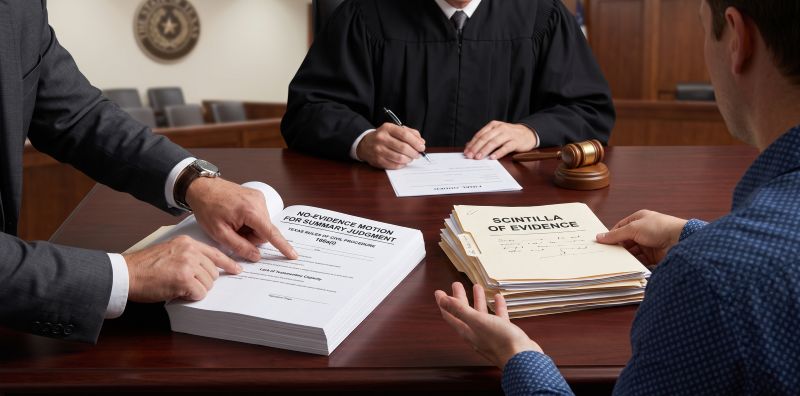
In Texas litigation, when a dispute drags on without supporting factual proof, defendants often reach for a critical procedural tool: the No-Evidence Motion for Summary Judgment. Commonly referred to as the "put up or shut up" motion, this filing forces the non-moving party to produce admissible evidence supporting their claims or face an immediate dismissal of their lawsuit before trial.
While traditional summary judgments require the party filing the motion to conclusively prove their case on paper, a no-evidence motion flips the burden entirely onto the opposing party.
Understanding TRCP 166a(i) and the Scintilla Standard
No-evidence motions for summary judgment are governed by Rule 166a(i) of the Texas Rules of Civil Procedure.
Under TRCP 166a(i), after an adequate time for discovery has passed, a party may move for summary judgment on the grounds that there is no evidence to support one or more essential elements of the adverse party's claim or defense.
- The Movant’s Assertion: The party filing the motion does not need to submit their own evidence. They simply point out the specific elements of the claim that lack evidentiary support.
- The Burden Shift: Once filed, the burden shifts completely to the non-moving party to respond with competent summary judgment evidence.
- The "Scintilla of Evidence" Standard: To survive dismissal, the responding party must produce more than a "scintilla" of evidence—meaning more than a mere surmise or suspicion—raising a genuine issue of material fact on each challenged element.
If the responding party fails to present more than a scintilla of evidence, the judge is required by law to grant the motion and dismiss the challenged claims.
Applying No-Evidence Motions in Will Contests and Estate Litigation
While no-evidence motions can be used across various civil disputes, they are particularly effective in Texas probate litigation and will contests.
It is common for disinherited relatives or unsatisfied heirs to challenge a last will and testament simply because they are unhappy with the distribution of assets. However, disliking a decedent's choices does not constitute a valid cause of action.
In these scenarios, the estate's executor can file a no-evidence motion asserting that the contestants have produced zero factual evidence of:
- Lack of Testamentary Capacity: Proof that the testator did not understand the business in which they were engaged or the effect of executing the will.
- Undue Influence: Evidence demonstrating that another party exerted control that overpowered the testator's mind at the time of execution.
If the contestants cannot produce sworn affidavits, medical records, or deposition testimony supporting these claims, the court will dismiss the contest, allowing the estate administration to proceed.
Judicial Discretion and Settlement Signals
Even when a party files a well-founded no-evidence motion, judges are naturally cautious about ending lawsuits before trial.
If a responding party produces even a minimal amount of evidence—such as a single sworn affidavit from a caretaker alleging erratic behavior—the judge will likely deny the motion.
However, a summary judgment hearing still serves a strategic purpose. When a judge indicates that a case barely survived a no-evidence motion, it signals to both parties that the claims are weak. This judicial feedback often encourages the parties to come to the negotiating table and settle the matter without incurring the heavy expense of a full trial.
Whatever the subject matter of your lawsuit, consulting an experienced Texas litigation attorney ensures your rights are protected throughout the summary judgment process.
All information provided on Silblawfirm.com (hereinafter "website") is provided for informational purposes only, and is not intended to be used for legal advice. Users of this website should not take any actions or refrain from taking any actions based upon content or information on this website. Users of this site should contact a licensed Texas attorney for a full and complete review of their legal issues.