
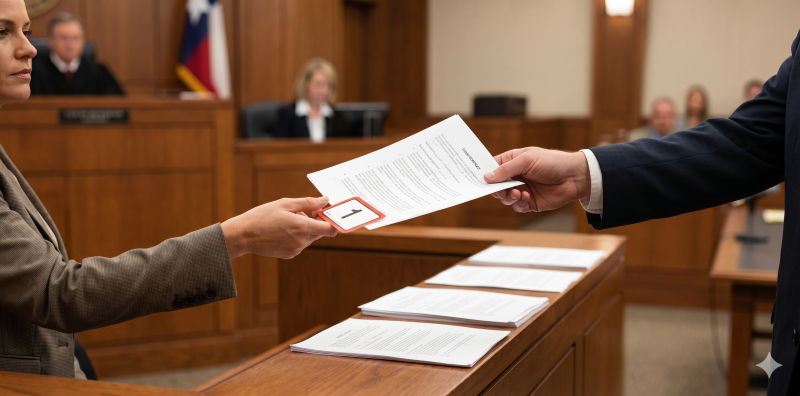
If you are heading to trial, you might assume that presenting a crucial document like a signed lease or a business contract is as simple as handing it to the judge and pointing out the important clauses. However, the courtroom is bound by strict procedural rules. You cannot simply start reading from a piece of paper; it must be formally introduced, authenticated, and admitted into evidence first.
Understanding the step-by-step process of getting documentary evidence on the record is critical to ensuring your case does not get derailed by procedural objections.
Step 1: Marking the Exhibit and Creating a Clean Record
The first step in getting a document admitted is ensuring that the court reporter can accurately track what is happening. Because most courtrooms rely on a written transcript rather than a video recording, you must verbally identify exactly what you are doing.
When your witness (for example, a property manager) is on the stand, you approach them and hand them the document. The standard legal script is: "I am handing you what has been labeled as Plaintiff's Exhibit One." Once the document is in the witness's hands, you must authenticate it under the rules of evidence. You do this by asking basic foundational questions:
- "Do you recognize that document?"
- "What is that document?"
If the witness confirms they recognize it (e.g., "Yes, this is the lease agreement we entered into with the defendant"), you have laid the initial groundwork for authentication.
Step 2: Laying the Business Record Predicate
While simply identifying a document might work if opposing counsel is cooperative, a seasoned attorney will not let you take shortcuts. To bulletproof your evidence against a hearsay objection, you must lay a formal "business record predicate."
Under Texas Rule of Evidence 803(6) (and similar federal rules), records of a regularly conducted business activity are an exception to the hearsay rule. To get the document admitted under this exception, you must ask the witness a specific series of questions to establish that:
- The document was made at or near the time of the event.
- It was made by or from information transmitted by someone with knowledge.
- It was kept in the course of a regularly conducted business activity.
- It was the regular practice of that business to make the record.
By walking the witness through these questions, you preemptively defeat hearsay and authenticity objections before opposing counsel even has a chance to raise them.
Step 3: Logistics and the Formal Offer
Handling the physical logistics of documentary evidence is just as important as the verbal script. A common rookie mistake is walking up to the witness stand with only one copy of the document.
In standard courtroom procedure, you should always bring four copies of any exhibit:
- One copy for the witness to hold and review.
- One copy for the opposing counsel.
- One copy for the court reporter (for the official record).
- One copy for yourself to reference.
Once copies are distributed and the witness has authenticated the document, you make the formal request to the judge: "Your Honor, I offer Exhibit One into evidence."
At this point, the judge will look to the opposing counsel to see if they have any objections (such as hearsay, relevance, or lack of foundation). If opposing counsel says, "No objections," or if the judge overrules their objection, the judge will declare, "Exhibit One is admitted." Only after hearing those magic words can you or your witness begin reading from the document or discussing its specific contents.
All information provided on Silblawfirm.com (hereinafter "website") is provided for informational purposes only, and is not intended to be used for legal advice. Users of this website should not take any actions or refrain from taking any actions based upon content or information on this website. Users of this site should contact a licensed Texas attorney for a full and complete review of their legal issues.