
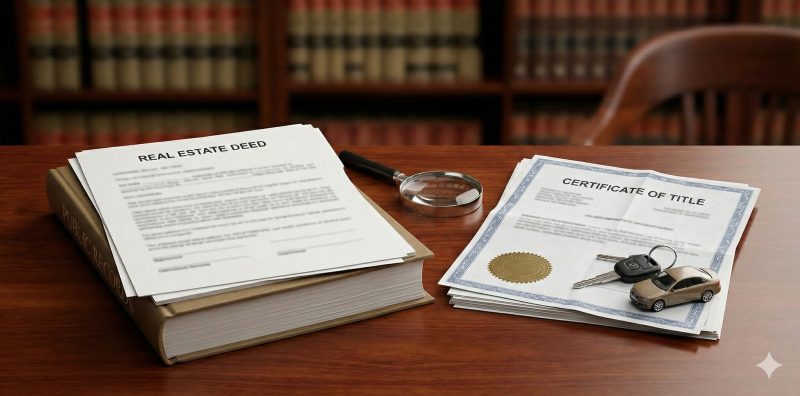
Many people assume that owning a home is just like owning a car—that there is a single piece of paper you hold onto to prove you own it. However, in Texas, the legal reality of property deeds and vehicle titles couldn't be more different. Understanding these distinctions is critical for anyone buying or selling assets privately.
The Paper Myth: Possession vs. Public Record
A common question attorneys receive is, "Where is my deed?" Clients often expect a possessory document similar to a car title. In reality, real estate ownership is established through a chain of title in public records. When you buy a house, a new document is created and recorded in the county's real property records. You don't need to physically hold the original deed to prove you own the home; the record itself is the authority.
Car titles, on the other hand, are strictly possessory. Under the Texas Transportation Code, the physical title is the primary evidence of ownership. When you sell a car, you physically sign that document over to the buyer. Unlike a house, where you already have the deed even if you have a mortgage, a vehicle lienholder (the bank) will typically hold onto your physical title until the loan is fully paid off.
Liens and the "Theory" of Ownership
Texas is a "Title Theory" state for real estate, meaning we believe the homeowner holds the legal title while the lender holds a lien. This is why a mortgage company doesn't send you a deed when you pay off your house; you’ve actually had the deed since the day you closed.
Vehicles operate differently. In Texas, the lienholder keeps the title as collateral. If you are a buyer in a private sale, it is vital to perform a lien search on the Texas Department of Motor Vehicles (TxDMV) website. If a lien exists, the seller must provide proof of a lien release before you can successfully apply for a new title in your name.
All information provided on Silblawfirm.com (hereinafter "website") is provided for informational purposes only, and is not intended to be used for legal advice. Users of this website should not take any actions or refrain from taking any actions based upon content or information on this website. Users of this site should contact a licensed Texas attorney for a full and complete review of their legal issues.